 What Is a Performance Management System?
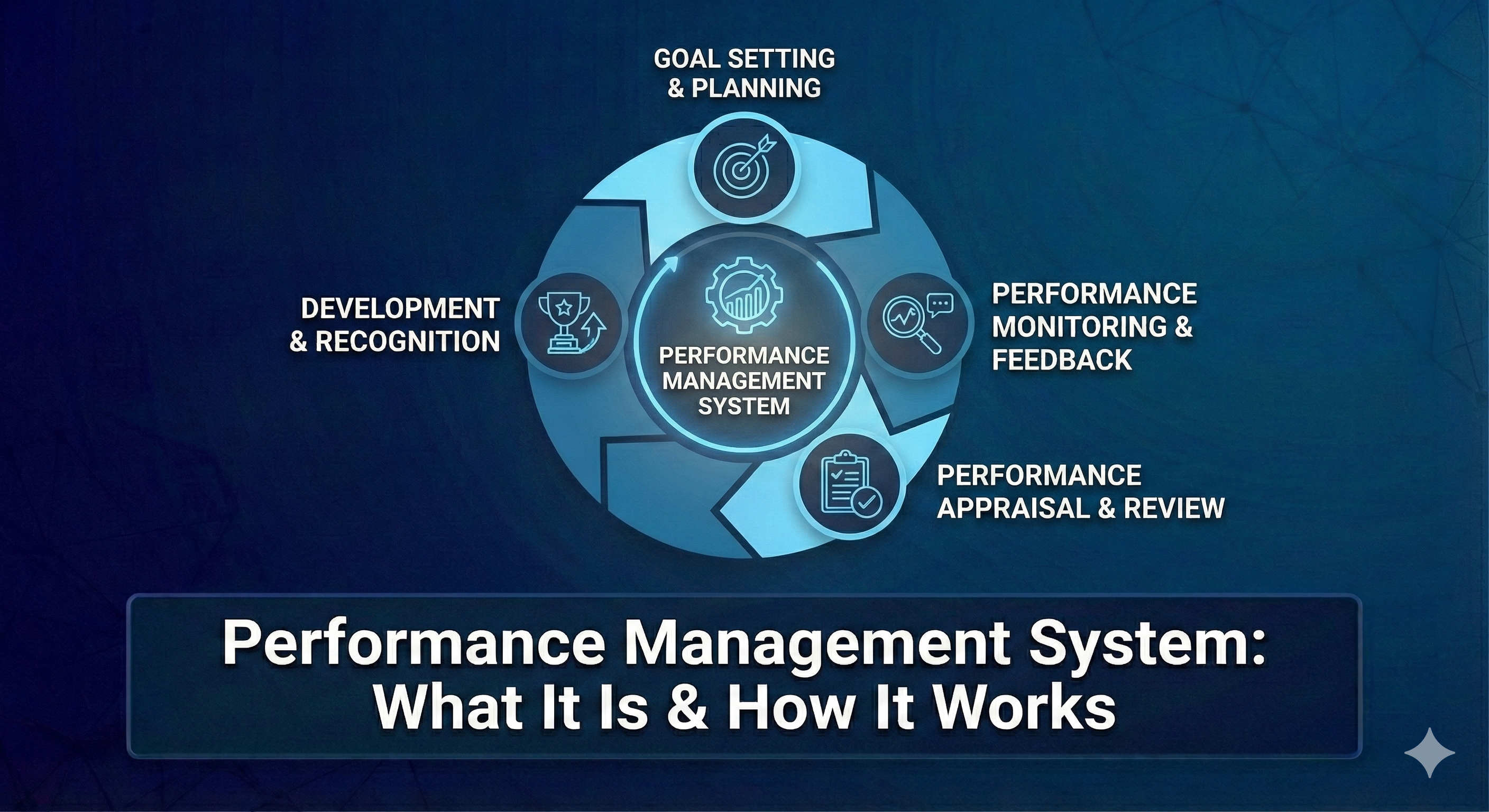
Performance Management System: What It Is & How It Works

Why Performance Management Is a Boardroom Priority Today
For decades, performance management was treated as an annual HR ritual forms, ratings, and reviews that rarely changed outcomes. However, in today’s volatile, skill-driven, and hybrid-first business environment, that approach is no longer sufficient.
For C-suite leaders, performance is no longer about measuring effort. It is about aligning people outcomes with business strategy, driving accountability, and building high-performing, future-ready organizations.
This is where a modern performance management system becomes critical. It moves performance from a static HR process to a continuous, data-driven leadership discipline one that directly impacts revenue growth, workforce productivity, and organizational resilience.
In this guide, we will break down exactly what a performance management system is, how it works in real organizations, and why forward-looking enterprises are rethinking performance altogether.
What Is a Performance Management System?
A performance management system is a structured, ongoing process that enables organizations to plan, track, evaluate, and improve employee performance in alignment with business objectives.
Unlike traditional appraisal-driven models, a modern system is not a single event. Instead, it is an interconnected framework that combines goal setting, feedback, coaching, measurement, and development into a continuous cycle.
At the leadership level, performance management answers three critical questions:
Are employees working on the right priorities?
Are managers enabling consistent performance improvement?
Is the organization generating measurable business impact from its talent investments?
When executed correctly, a performance management system becomes a strategic operating layer not just an HR tool.
Why Performance Management Systems Matter More Than Ever
The relevance of performance management has increased dramatically due to structural shifts in how organizations operate.
First, work itself has changed. Distributed teams, cross-functional collaboration, and project-based roles require real-time visibility, not annual retrospection.
Second, workforce expectations have evolved. Employees now seek clarity, fairness, growth, and regular feedback, not delayed evaluations.
Finally, business volatility demands agility. Leadership teams need systems that can surface performance risks early, adapt goals quickly, and identify high-potential talent with confidence.
This is why enterprises are replacing legacy reviews with technology-enabled employee performance management frameworks that support speed, transparency, and accountability.
How a Performance Management System Works: The End-to-End Cycle
A modern performance management system operates as a continuous loop rather than a linear checklist. Each stage reinforces the next, creating a self-correcting performance ecosystem.
Goal Setting and Alignment
The process begins with translating organizational strategy into clear, measurable, and role-specific goals.
At the executive level, this ensures that business priorities cascade logically across departments, teams, and individuals.
Effective systems support structured goal frameworks such as OKRs or KPIs while allowing flexibility for changing priorities. When goals are visible and aligned, employees understand how their work contributes to outcomes that matter.
Platforms like JioHRMS enable organizations to define and align goals centrally, ensuring strategic coherence without micromanagement.
Continuous Performance Tracking
Once goals are defined, performance must be tracked in real time. This includes milestones, progress updates, and qualitative inputs.
Unlike manual spreadsheets or disconnected tools, a digital performance management system captures performance data continuously, giving leaders early visibility into risks and achievements.
This approach eliminates surprises at review time and empowers managers to act before performance gaps widen.
Feedback and Coaching
Modern performance management recognizes that feedback is most effective when it is frequent, contextual, and constructive.
Instead of one-way evaluations, organizations are shifting toward two-way feedback, peer inputs, and manager coaching conversations.
This is where employee performance management becomes developmental rather than judgmental. Employees receive guidance while performance is still adjustable, not after outcomes are locked in.
JioHRMS supports structured feedback workflows that promote consistency while preserving managerial discretion.
Performance Reviews and Appraisals
Formal reviews remain important, but their role has evolved. Today, appraisals serve as decision checkpoints, not discovery exercises.
A robust system consolidates goals, feedback, and performance data into a transparent review process that reduces bias and subjectivity.
Advanced performance appraisal software enables standardized evaluations while allowing qualitative judgment where it matters.
For leadership, this ensures that compensation, promotions, and succession decisions are backed by evidence rather than perception.
Development and Growth Planning
Performance management does not end with ratings. In fact, its most strategic value lies in what happens next.
Insights from reviews inform personalized development plans, learning investments, and internal mobility decisions.
Organizations that link performance outcomes with growth pathways consistently outperform those that treat appraisals as administrative closures.
By integrating performance with learning and career planning, systems like JioHRMS help organizations convert performance insights into long-term capability building.
Traditional vs Modern Performance Management Systems
Understanding the evolution of performance management helps explain why many organizations struggle with engagement and accountability.
Traditional systems were infrequent, retrospective, and manager-centric. They emphasized compliance over improvement and often failed to motivate high performers.
Modern systems, by contrast, are continuous, transparent, and employee-centric. They emphasize alignment, feedback, and development, supported by real-time data.
For C-suite leaders, this shift is not optional. It is a necessary response to complexity, scale, and competitive pressure.
The Strategic Role of Performance Management for the C-Suite
At the executive level, a performance management system is not just about evaluating employees it is about governing performance at scale.
It enables leaders to:
Link workforce outcomes directly to business KPIs
Identify high performers and critical skill gaps early
Strengthen managerial effectiveness across layers
Improve pay-for-performance credibility
Support succession and leadership planning
In effect, performance management becomes a control system for organizational execution.
Key Features of an Effective Performance Management System
Not all systems deliver strategic value. High-impact platforms share certain characteristics.
They are intuitive enough for daily use, yet powerful enough for enterprise analytics. They support customization without fragmentation and standardization without rigidity.
JioHRMS is designed with these principles in mind, offering configurable workflows, integrated feedback, and performance analytics that scale with organizational complexity.
Performance Management and Organizational Culture
Performance systems shape behavior. What gets measured, reviewed, and rewarded eventually defines culture.
Organizations that emphasize clarity, fairness, and development through their performance frameworks build trust and accountability.
Conversely, opaque or inconsistent systems erode engagement, even when compensation is competitive.
By embedding transparency and consistency, a modern performance management system reinforces a culture of ownership and continuous improvement.
Measuring the ROI of Performance Management
C-suite leaders often ask whether performance management delivers tangible returns. The answer lies in outcomes, not processes.
Effective systems improve productivity, reduce regretted attrition, strengthen leadership pipelines, and enhance engagement scores.
When performance data is integrated with workforce analytics, organizations can correlate performance trends with revenue growth, customer satisfaction, and operational efficiency.
This is where technology-enabled platforms like JioHRMS create measurable value without adding administrative overhead.
Common Challenges and How Organizations Overcome Them
Even with the right intent, performance management initiatives often fail due to poor adoption, unclear expectations, or managerial resistance.
Successful organizations address these challenges by simplifying workflows, training managers, and reinforcing performance conversations as part of everyday leadership not annual compliance.
Technology acts as an enabler, but leadership commitment remains the differentiator.
The Future of Performance Management Systems
Performance management is moving toward greater personalization, predictive analytics, and continuous intelligence.
AI-driven insights, skill-based evaluations, and real-time performance nudges are becoming mainstream.
However, the core principle remains unchanged: performance systems must serve both people growth and business outcomes.
Organizations that invest early in modern frameworks will be better positioned to adapt, scale, and compete.
Final Thoughts: Turning Performance into a Strategic Advantage
For organizations aiming to scale sustainably, performance management can no longer remain an HR formality. It must evolve into a leadership-led, technology-enabled, and outcome-driven system.
When designed thoughtfully, a performance management system does more than evaluate employees it activates potential, strengthens execution, and future-proofs the enterprise.