 What Is an Employee Self Service (ESS) Portal?
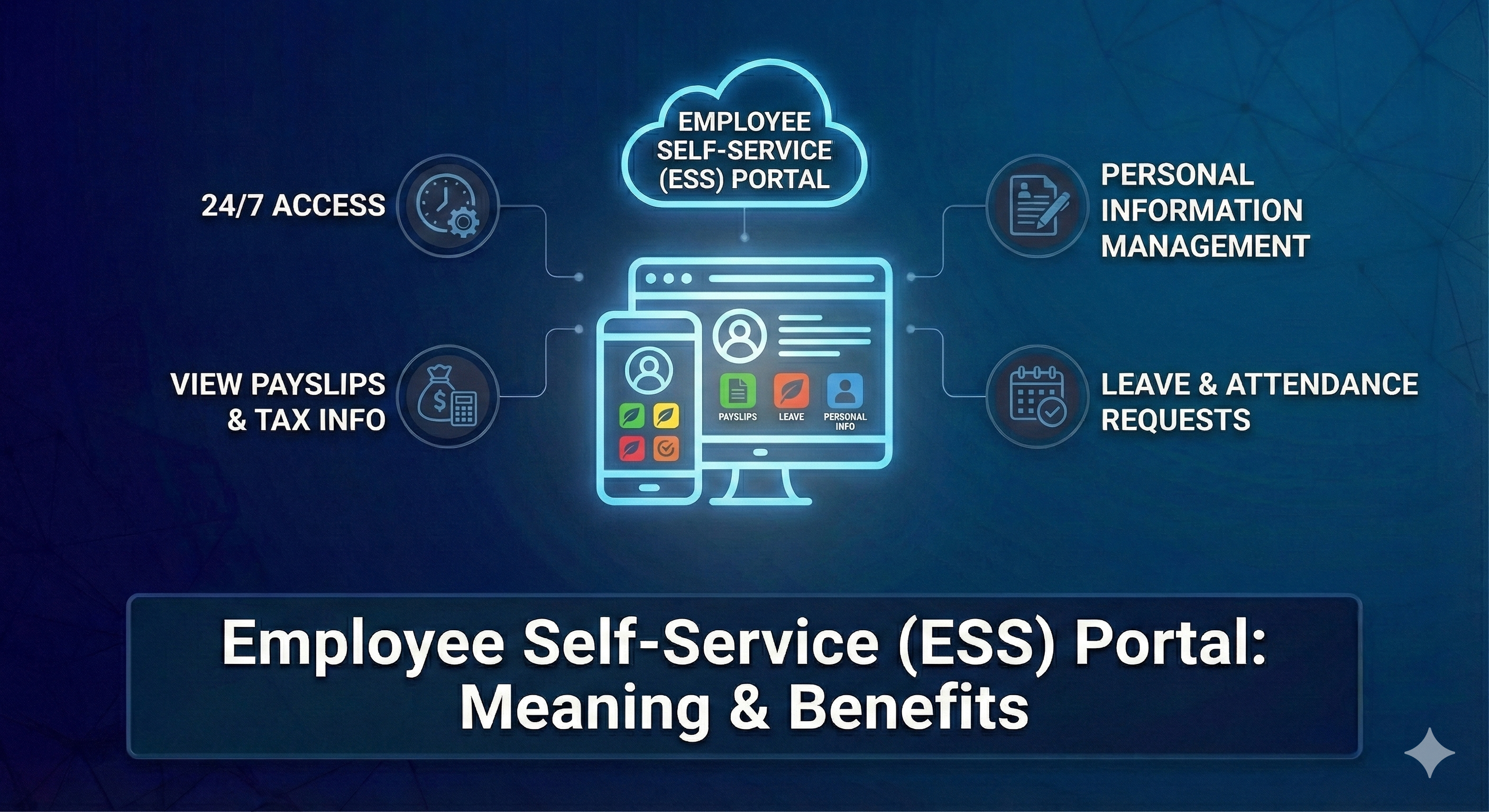
Employee Self-Service (ESS) Portal: Meaning & Benefits

Why C-Suite Leaders Are Rethinking HR Operations
In today’s enterprise environment, leadership conversations are no longer limited to revenue growth and market expansion. Increasingly, operational efficiency, employee experience, and digital governance dominate boardroom agendas.
As organizations scale, HR functions often become bottlenecks rather than enablers. Routine employee queries, manual documentation, delayed approvals, and fragmented data silently drain productivity across the enterprise.
This is precisely where a modern employee self service portal becomes a strategic asset rather than just an HR feature.
For CXOs, CHROs, CEOs, and CFOs, understanding the true meaning and business impact of Employee Self-Service (ESS) is essential for building a future-ready organization.
What Is an Employee Self Service (ESS) Portal?
An employee self service portal is a secure digital interface that allows employees to directly access, update, and manage their HR-related information without depending on HR personnel for routine tasks.
Instead of sending emails, filling physical forms, or following up manually, employees can independently handle activities such as:
Viewing salary slips and tax documents
Applying for leave and tracking balances
Updating personal and banking details
Accessing company policies
Checking attendance and shift schedules
From a leadership perspective, ESS represents a shift in HR operating modelsfrom administrative execution to strategic workforce enablement.
The Evolution of Employee Self Service in HR
Traditionally, HR departments were designed to control information flow. However, as organizations grew more complex, this centralized approach became unsustainable.
Key Drivers Behind ESS Adoption
Workforce scale and geographic distribution
Rise of remote and hybrid work models
Demand for real-time information access
Regulatory pressure on payroll and compliance
Expectation of consumer-grade digital experiences
Modern employee self service HR platforms emerged as a response to these pressures, empowering employees while maintaining organizational governance.
Why Employee Self Service Portals Matter to the C-Suite
While ESS portals are often positioned as HR tools, their strategic impact extends far beyond HR.
1. Cost Optimization at Scale
Routine HR transactions account for a significant portion of operational cost. By enabling employees to self-serve, enterprises reduce:
HR staffing overhead
Paper-based processes
Error correction expenses
For CFOs, a well-implemented employee self service portal directly contributes to margin improvement.
2. Productivity Gains Across the Organization
Every HR query resolved manually translates into lost productivity. ESS portals eliminate unnecessary friction, allowing employees and managers to focus on core business outcomes.
3. Governance, Accuracy, and Compliance
Self-updated data with built-in validations improves accuracy while maintaining audit trails. Integrated ESS portal HRMS solutions help organizations meet statutory and internal compliance requirements with confidence.
Core Features of a Modern Employee Self Service Portal
A robust ESS solution is not defined by feature volume, but by business relevance, usability, and integration depth.
Employee Information Management
Employees can securely update personal data such as address, emergency contacts, and bank details. This ensures records remain current without HR intervention.
Leave and Attendance Management
Employees can apply for leave, track approvals, and view attendance records in real time. Managers benefit from faster decision-making and visibility.
Payroll and Tax Access
Instant access to payslips, Form 16, and compensation breakdowns improves transparency and reduces payroll queries significantly.
Policy and Document Access
Employees can view company policies, letters, and compliance documents anytime, reducing dependency on HR teams.
Mobile Accessibility
With increasingly mobile workforces, ESS portals must be accessible across devices, enabling engagement beyond office premises.
ESS Portal and HRMS: Why Integration Is Non-Negotiable
Standalone ESS tools often fail to deliver long-term value. The real power emerges when ESS is embedded within a comprehensive HRMS ecosystem.
An integrated ess portal hrms ensures:
Single source of truth for employee data
Real-time synchronization across payroll, attendance, and compliance
Consistent user experience across HR functions
Platforms like JioHRMS design ESS as a native capability, not an add-on, ensuring reliability and scalability.
Strategic Benefits of Employee Self Service Portals
Improved Employee Experience (EX)
Employees expect the same digital convenience at work that they experience as consumers. ESS portals reduce frustration, build trust, and enhance engagement.
HR Transformation from Operations to Strategy
By automating transactional tasks, HR leaders can focus on workforce planning, culture building, and leadership development.
Faster Decision-Making
Real-time access to accurate data empowers managers and leaders to make informed decisions without delays.
Data Security and Role-Based Access
Modern ESS software ensures sensitive information is accessible only to authorized users, reducing risk exposure.
Employee Self Service and Organizational Scalability
As organizations expand, HR complexity increases exponentially. ESS portals scale seamlessly without proportional increases in HR headcount.
For fast-growing enterprises, ESS becomes a foundational layer for sustainable growth.
ESS in the Context of Remote and Hybrid Work
The shift toward distributed workforces has permanently changed HR operations.
An effective employee self service portal ensures continuity by enabling employees to:
Access HR services from anywhere
Stay aligned with organizational policies
Maintain engagement despite physical distance
This capability is no longer optionalit is mission-critical.
ESS Software and Data-Driven Leadership
Modern ESS platforms generate valuable workforce data, including:
Leave trends
Attendance patterns
Employee engagement indicators
When integrated into analytics frameworks, ESS data supports strategic forecasting and workforce optimization at the leadership level.
How JIO HRMS Enables Value-Driven Employee Self Service
JioHRMS approaches ESS from a business enablement perspective, focusing on simplicity, compliance readiness, and scalability.
Without being promotional, it is worth noting that JioHRMS ESS capabilities are designed to:
Align with Indian statutory frameworks
Support growing and enterprise-grade organizations
Integrate seamlessly with payroll, attendance, and compliance modules
Offer intuitive experiences for both employees and administrators
This design philosophy ensures ESS adoption drives measurable outcomes rather than becoming underutilized software.
Common Challenges in ESS Adoption (and How to Avoid Them)
Low Adoption Rates
Poor UX and lack of communication often result in underutilization. Leadership sponsorship and intuitive design are key.
Data Security Concerns
Choosing ESS platforms with robust security frameworks and role-based access controls mitigates risk.
Fragmented Systems
Avoid ESS tools that operate in silos. Integrated HRMS platforms deliver higher long-term ROI.
ESS Portal Implementation: What Leaders Should Evaluate
Before investing in an employee self service HR solution, CXOs should assess:
Ease of use for non-technical employees
Integration with existing HR and payroll systems
Compliance readiness
Vendor credibility and support maturity
Scalability over the next 3–5 years
The Future of Employee Self Service Portals
ESS portals are evolving beyond transactional interfaces into intelligent employee platforms.
Future capabilities include:
AI-driven recommendations
Predictive workforce insights
Conversational interfaces
Hyper-personalized employee journeys
Organizations that invest early will gain a significant competitive advantage in talent management.
Final Thoughts: ESS as a Strategic Business Enabler
An employee self service portal is no longer an HR convenience it is a strategic necessity.
For leadership teams focused on efficiency, governance, and employee experience, ESS delivers measurable value across the enterprise.
When implemented thoughtfully within a robust HRMS framework, ESS empowers employees, elevates HR, and strengthens organizational resilience.
Make your HR Software fun and easy!
Learn how JIO HRMS Software can help you automate HR processes and stay 100% compliant.