 What Is the Minimum Wages Act in India?
Minimum Wages Act Explained for HR Teams: A Complete Compliance Guide for Indian Employers

Why the Minimum Wages Act Matters More Than Ever
In today’s regulatory-heavy business environment, compliance is no longer a back-office task. For HR leaders and C-suite executives, statutory compliance directly impacts brand trust, operational continuity, and investor confidence.
Among India’s most critical labour regulations, the Minimum Wages Act India stands out as a foundational law that governs employee compensation. While the Act has existed for decades, its interpretation, enforcement, and relevance have evolved significantly especially with the introduction of wage codes and digital compliance audits.
For HR teams, understanding the minimum wages law is not optional. It is essential for avoiding penalties, ensuring ethical pay practices, and maintaining payroll accuracy across multiple states and employee categories.
This guide explains the Minimum Wages Act in clear, business-focused language helping decision-makers understand what it means, how it affects payroll, and how modern HR teams manage compliance efficiently.
What Is the Minimum Wages Act in India?
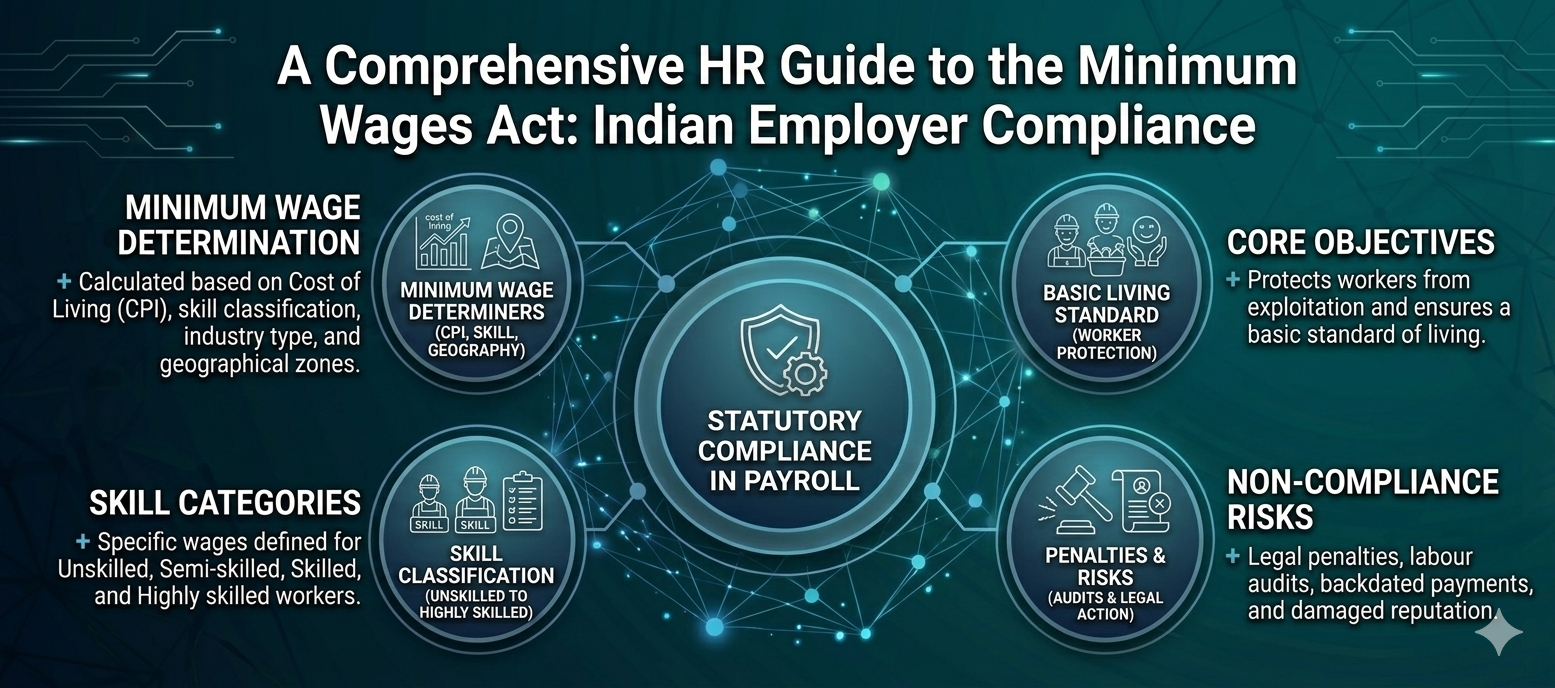
The Minimum Wages Act India, enacted in 1948, empowers the government to fix minimum rates of wages for employees working in scheduled employments. Its primary objective is to protect workers from exploitation and ensure a basic standard of living.
Unlike uniform wage laws, minimum wages in India vary based on several factors:
State and location
Type of industry or employment
Skill level of the worker
Nature of work (skilled, semi-skilled, unskilled)
This variability makes compliance particularly complex for organizations operating across multiple locations.
From an HR perspective, the Act is not just about paying the lowest legally allowed salary it is about structuring payroll in a way that remains compliant at all times, even when wage rates change.
Why the Minimum Wages Act Is Critical for HR Teams and Employers
For senior HR leaders, the Minimum Wages Act India intersects directly with payroll governance, risk management, and employee relations.
Failure to comply can result in:
Legal penalties and fines
Backdated wage payments
Labour inspections and audits
Damage to employer brand
Increased employee disputes
In contrast, organizations that proactively align with minimum wage regulations experience smoother payroll operations and stronger workforce trust.
HR teams are expected to act as compliance custodians, ensuring that every employee whether permanent, contractual, or temporary is paid according to the applicable minimum wage.
Key Objectives of the Minimum Wages Act
The Act is designed around three core principles:
First, it ensures that workers receive wages sufficient to meet basic needs such as food, shelter, and clothing.
Second, it prevents unfair wage competition among employers by setting a legal wage floor.
Third, it empowers state governments to revise wages periodically, keeping pace with inflation and economic changes.
For HR teams, these objectives translate into a continuous responsibility to monitor wage notifications and reflect them accurately in payroll systems.
Who Is Covered Under the Minimum Wages Act?
The Minimum Wages Act India applies to all employees working in scheduled employments, as notified by central and state governments.
Coverage includes:
Permanent employees
Contract and temporary workers
Daily wage and piece-rate workers
Employees in both organized and unorganized sectors
Even senior management must ensure that junior staff, outsourced roles, and third-party payroll arrangements comply with applicable minimum wage rules.
This is where payroll governance becomes complex, especially when HR teams rely on manual processes or fragmented systems.
How Minimum Wages Are Determined in India
One of the most misunderstood aspects of the minimum wages law is how wage rates are calculated.
Minimum wages are determined based on:
Cost of living index (CPI)
Skill classification
Industry category
Geographical zone (metro, non-metro, rural)
State governments notify wage rates and revise them periodically, usually every six months or annually through Variable Dearness Allowance (VDA).
For HR teams, tracking these revisions manually is both time-consuming and error-prone, particularly in multi-state payroll setups.
Skill Categories Under the Minimum Wages Act
Wages differ significantly based on skill classification. Employees are broadly categorized as:
Unskilled
Semi-skilled
Skilled
Highly skilled
Incorrect classification can result in underpayment, even if the total salary appears competitive.
HR teams must clearly define job roles, map them to correct skill categories, and ensure payroll reflects the legally mandated wage for that category.
Minimum Wages vs Living Wages: A Strategic Perspective
While the Minimum Wages Act India defines the legal floor, many progressive organizations aim to pay living wages.
However, from a compliance standpoint, HR teams must ensure that no employee falls below the statutory minimum, regardless of incentives or variable pay.
C-suite leaders should view minimum wages not just as a cost factor, but as a compliance baseline that supports long-term workforce stability.
Impact of the Code on Wages on Minimum Wage Compliance
The introduction of the Code on Wages aims to consolidate multiple wage-related laws, including the Minimum Wages Act.
While the Code seeks to simplify definitions and standardize wage calculations, enforcement of minimum wages remains state-driven.
HR leaders must prepare for increased scrutiny and digitized compliance audits under the new framework.
Common Compliance Challenges Faced by HR Teams
Despite clear regulations, many organizations struggle with compliance due to:
Frequent state-wise wage revisions
Multiple payroll structures
Manual salary calculations
Lack of real-time compliance visibility
These challenges increase compliance risk, especially during labour inspections or statutory audits.
This is where technology plays a decisive role.
Role of Payroll Systems in Minimum Wage Compliance
Payroll is the execution layer of the Minimum Wages Act India. Even a minor calculation error can result in non-compliance.
Modern HR teams rely on payroll systems that:
Auto-update wage rates
Map employees to correct wage categories
Generate compliant salary structures
Maintain audit-ready records
Without automation, compliance becomes reactive rather than proactive.
How JioHRMS Supports Minimum Wages Act Compliance
JioHRMS is designed to simplify complex statutory requirements without adding operational burden.
Instead of manual tracking, HR teams can use JioHRMS to:
Configure state-wise minimum wage rules
Ensure payroll never falls below statutory limits
Maintain historical wage revision records
Generate compliant payroll reports
The platform supports payroll governance in a way that aligns with payroll compliance India expectations, while giving leadership complete visibility.
Importantly, compliance is embedded into daily HR operations, not treated as a separate task.
Minimum Wages Act and Labour Law Audits
Labour audits increasingly focus on wage compliance, documentation accuracy, and historical payroll data.
Auditors typically examine:
Wage registers
Attendance records
Salary slips
Bank payment proofs
HR teams using integrated HRMS platforms find it easier to respond to audits with confidence, accuracy, and speed.
Penalties for Non-Compliance Under the Minimum Wages Act
Non-compliance can attract serious consequences, including:
Monetary fines
Legal prosecution
Payment of wage differentials with penalties
For senior leadership, these risks translate into financial exposure and reputational damage.
Preventive compliance is always more cost-effective than corrective action.
Best Practices for HR Leaders to Ensure Compliance
To remain compliant with the minimum wages law, HR teams should:
Regularly review state wage notifications
Audit payroll structures periodically
Automate compliance wherever possible
Maintain accurate employee classification
Forward-looking HR leaders treat compliance as a strategic capability rather than a regulatory burden.
Why C-Suite Leaders Should Care About Minimum Wage Compliance
For CEOs, CFOs, and CHROs, compliance reflects governance maturity.
Consistent adherence to the Minimum Wages Act India signals ethical leadership, operational discipline, and readiness for scale especially important for organizations planning expansion or investment.
The Future of Wage Compliance in India
As India moves toward consolidated labour codes and digital inspections, wage compliance will become more transparent and data-driven.
HR teams that adopt technology early will gain a competitive advantage by reducing risk, improving accuracy, and freeing up strategic bandwidth.
Final Thoughts: Turning Compliance into Competitive Advantage
The Minimum Wages Act India is not merely a statutory obligation it is a foundational element of responsible workforce management.
Organizations that invest in compliance-ready systems and informed HR leadership are better positioned to scale sustainably and earn long-term trust.
With the right HRMS in place, compliance becomes seamless, predictable, and audit-ready.
Call to Action
Simplify Wage Compliance for Your HR Team
If your HR team is still managing wage compliance manually, it may be time to rethink the approach.
Explore how JioHRMS helps modern organizations simplify payroll compliance, reduce statutory risk, and stay future-ready without adding operational complexity.
See how compliance can work smarter for your business.