 Understanding Payroll Errors: Types, Causes & Business Risks
How to Reduce Payroll Errors Using HR Software

The Real Cost of Payroll Errors
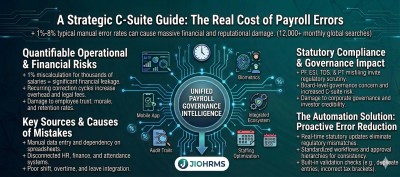
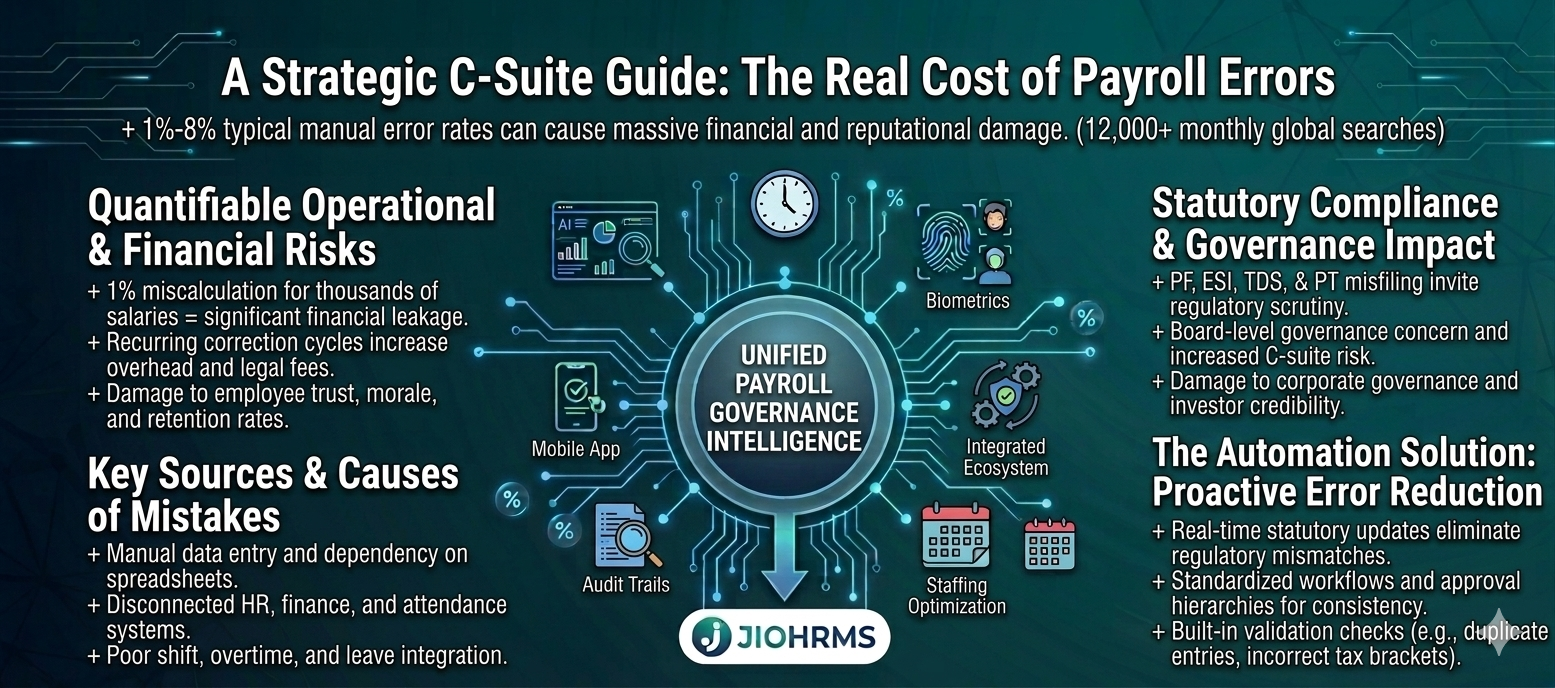
According to industry estimates, payroll error rates in manual environments range between 1% to 8%. In enterprises processing thousands of salaries monthly, even a 1% miscalculation can translate into significant financial and reputational damage.
The global search volume for payroll errors exceeds 12,000+ searches per month, reflecting how widespread and urgent this challenge has become for HR and finance leaders.
For C-suite executives, payroll is not just an operational function. It is a strategic risk area. Incorrect salary disbursement, compliance violations, delayed payments, or tax miscalculations directly affect employee trust, regulatory exposure, and corporate governance.
The question is no longer whether errors exist. The real question is:
How can leadership systematically reduce payroll errors using HR software?
This guide provides a research-backed, executive-level roadmap.
Understanding Payroll Errors: Types, Causes & Business Risks
Before reducing payroll errors, leaders must understand their origin.
Common Types of Payroll Errors
Organizations frequently encounter:
Incorrect salary calculations
Overtime miscalculations
Tax deduction mistakes
PF, ESI, PT, and TDS misfiling
Duplicate payments
Missed compliance deadlines
Incorrect leave encashment
While these appear operational, their impact is strategic.
Root Causes of Payroll Mistakes
Most payroll mistakes stem from:
Manual data entry
Disconnected HR and finance systems
Spreadsheet dependency
Outdated compliance rules
Lack of audit trails
Poor attendance tracking integration
When payroll depends heavily on human intervention, risk multiplies.
For enterprises with multiple branches, variable pay structures, shift-based attendance, and complex tax regimes, manual workflows almost guarantee recurring payroll errors.
Why C-Suite Leaders Must Prioritize Payroll Accuracy
1. Financial Risk Exposure
Even minor recurring payroll errors can accumulate into large financial leakages. Overpayments and underpayments distort cash flow forecasting.
Additionally, regulatory penalties for tax and statutory non-compliance can be substantial.
2. Compliance & Legal Consequences
Non-compliance in PF, ESI, TDS, and labor laws invites scrutiny. Audits triggered by persistent payroll errors damage credibility with regulators and investors.
3. Employee Trust & Employer Branding
Salary is deeply personal. Even a single payroll mistake can reduce morale. Repeated inaccuracies harm retention rates and employer branding.
4. Board-Level Governance Concerns
CFOs and CHROs are increasingly accountable for internal control systems. Weak payroll governance exposes board-level risk.
Therefore, improving payroll accuracy is not optional. It is a strategic necessity.
How HR Software Reduces Payroll Errors
Modern HR software eliminates structural weaknesses in payroll processes. Instead of reactive correction, it enables preventive control.
Let us explore how.
1. Automation Eliminates Manual Data Entry Errors
Manual data entry remains the largest contributor to payroll errors.
HR software automates:
Salary structure configuration
Attendance integration
Overtime calculation
Leave encashment computation
Bonus and incentive payouts
With automated workflows, dependency on spreadsheets decreases drastically.
The result is measurable improvement in payroll accuracy.
Moreover, automation reduces fatigue-based human errors, especially in large payroll cycles.
This is where payroll automation benefits become visible at scale.
2. Real-Time Compliance Updates Reduce Regulatory Errors
India’s statutory landscape evolves frequently. Tax slabs, PF limits, professional tax rules, and state-level labor regulations change regularly.
Outdated compliance settings cause significant payroll errors.
Modern HR software, including platforms like JioHRMS, incorporates real-time compliance updates. When statutory rules are updated automatically, the risk of compliance-related payroll mistakes declines significantly.
For CFOs, this means reduced legal exposure.
For CHROs, it ensures smoother audits.
3. Integrated Attendance Systems Improve Payroll Accuracy
Disconnected attendance systems often create calculation mismatches.
For example:
Incorrect overtime logs
Missed shift differentials
Inaccurate leave tracking
When attendance and payroll operate separately, reconciliation becomes manual. This gap is a primary source of payroll errors.
Integrated HRMS platforms unify attendance management with payroll modules.
JioHRMS integrates biometric attendance, mobile check-ins, and shift management directly into payroll processing. Therefore, salary calculations reflect real-time attendance data.
This direct synchronization enhances payroll accuracy without additional administrative effort.
4. Built-In Validation Rules Prevent Payroll Mistakes
Advanced HR software uses validation engines.
Before payroll is finalized, the system checks:
Negative salary values
Excessive deductions
Incorrect tax brackets
Duplicate entries
Missing compliance fields
These automated checks act as internal audit controls.
Instead of discovering payroll errors after disbursement, organizations prevent them before processing.
This proactive approach dramatically reduces payroll mistakes.
5. Audit Trails Strengthen Internal Controls
Manual systems lack transparent audit trails. When discrepancies arise, tracing their origin becomes difficult.
Modern HRMS platforms maintain complete logs:
Who modified salary structure
When deductions were changed
What adjustments were applied
Why overrides were approved
This visibility improves accountability.
C-suite leaders gain confidence that payroll accuracy is supported by system-level controls rather than individual dependency.
6. Standardized Workflows Reduce Operational Variability
In decentralized organizations, payroll processes differ across locations.
Such inconsistencies increase payroll errors.
HR software standardizes:
Approval hierarchies
Salary processing timelines
Compliance reporting formats
Multi-branch payroll consolidation
With centralized control and location-wise flexibility, payroll becomes predictable and accurate.
This is one of the most underappreciated payroll automation benefits.
Quantifiable Payroll Automation Benefits for Enterprises
Reducing payroll errors is only one outcome. Automation also generates measurable ROI.
Cost Reduction
Organizations reduce correction cycles, legal fees, and administrative overhead.
Faster Processing Time
Payroll cycles shorten by 30–50% with automation.
Improved Payroll Accuracy Metrics
Error rates drop significantly after HRMS implementation.
Better Compliance Readiness
Audit preparation time reduces because documentation is centralized.
Strategic Workforce Insights
Integrated dashboards provide real-time payroll analytics for CFO-level decision-making.
JioHRMS offers analytics dashboards that provide visibility into payroll trends, tax liabilities, and workforce cost structures. Therefore, payroll transforms from an operational function into a strategic intelligence asset.
Executive Framework: How to Implement HR Software to Reduce Payroll Errors
For C-suite leaders, implementation strategy determines success.
Step 1: Conduct a Payroll Risk Audit
Assess:
Current payroll error frequency
Manual intervention points
Compliance exposure
Reconciliation cycles
Step 2: Define Automation Objectives
Clarify measurable goals:
Reduce payroll errors by 80%
Improve payroll accuracy above 99.5%
Cut processing time by 40%
Step 3: Choose an Integrated HRMS
Select software that includes:
Attendance integration
Compliance updates
Automated payroll calculations
Audit trails
Multi-location support
JioHRMS provides these features within a unified ecosystem.
Step 4: Implement Phased Rollout
Start with pilot branches before enterprise-wide deployment.
Step 5: Monitor Payroll Accuracy KPIs
Track:
Error frequency
Correction turnaround time
Compliance deviations
Employee payroll complaints
Continuous monitoring ensures sustainable reduction of payroll mistakes.
Why Manual Payroll Can No Longer Support Enterprise Growth
As organizations scale, payroll complexity multiplies.
Variable pay models, hybrid work environments, contract workforce management, and multi-state compliance structures increase error probability.
Without HR software, the likelihood of recurring payroll errors grows exponentially.
Moreover, reliance on individuals rather than systems creates institutional risk.
In contrast, automated HRMS platforms establish structured, repeatable, and auditable payroll processes.
The Strategic Advantage of Reducing Payroll Errors
When payroll errors decline:
Employee satisfaction increases
Compliance risk decreases
Leadership credibility strengthens
Operational efficiency improves
Finance forecasting becomes accurate
Ultimately, payroll accuracy contributes directly to enterprise stability.
C-suite leaders increasingly view payroll transformation as a governance initiative rather than an administrative upgrade.
How JioHRMS Supports Payroll Accuracy Without Complexity
While many HR tools offer automation, the true value lies in seamless integration.
JioHRMS combines:
Payroll processing
Attendance management
Statutory compliance
Leave management
Employee self-service portals
Real-time analytics dashboards
Because modules operate within a single ecosystem, data duplication disappears. This unified structure significantly reduces payroll errors.
Additionally, automated compliance updates minimize legal exposure.
Most importantly, the system is designed for scalability, enabling enterprises to grow without increasing payroll risk.
Conclusion: From Payroll Errors to Payroll Excellence
Reducing payroll errors is not merely about fixing calculations. It is about strengthening internal controls, protecting organizational reputation, and improving financial governance.
HR software transforms payroll from a reactive administrative task into a strategic function.
By eliminating manual processes, integrating attendance, automating compliance, and enabling audit transparency, enterprises achieve superior payroll accuracy.
For C-suite leaders, the decision is clear:
Modern payroll challenges require modern HR technology.
Call to Action
Modernize Your Payroll with JioHRMS
If your organization is still managing payroll through spreadsheets or disconnected systems, now is the time to evaluate a smarter approach.
Discover how JioHRMS can help your enterprise reduce payroll errors, improve payroll accuracy, and unlock measurable payroll automation benefits.
Visit jiohrms.com to schedule a strategic consultation and see how intelligent HR software can future-proof your payroll operations.