 Understanding Statutory Payroll Deductions in India
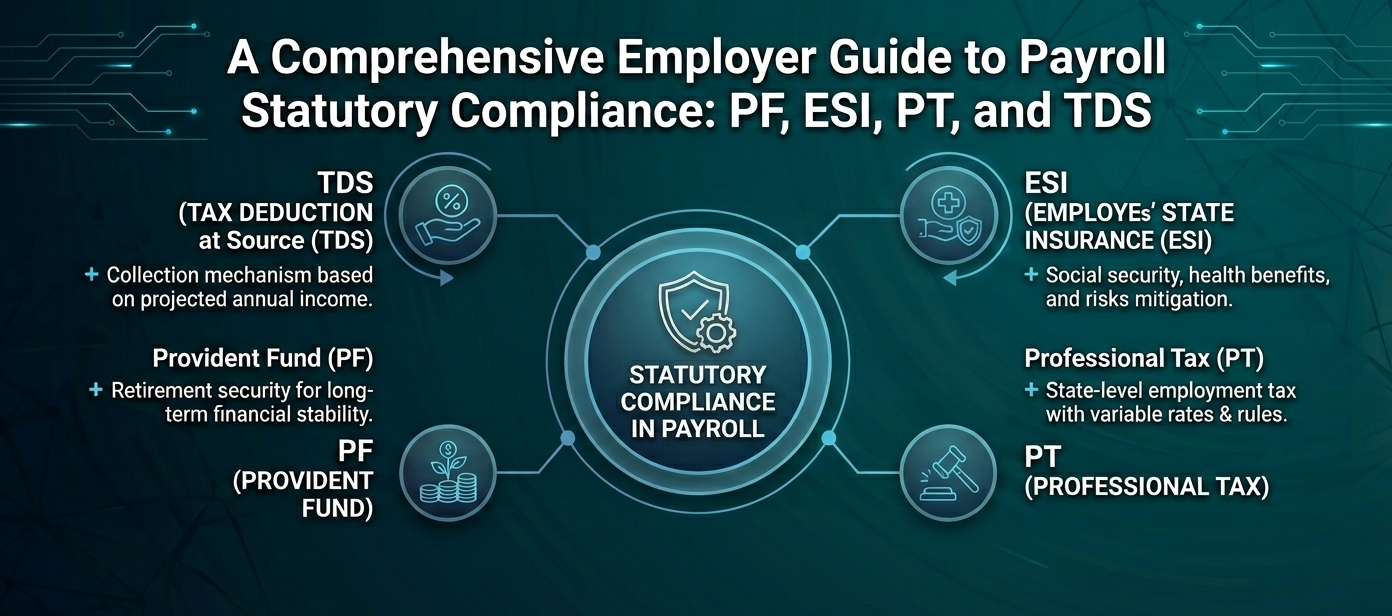
What Is PF, ESI, PT & TDS? Explained for Employers

Introduction: Why Statutory Compliance Matters to the C‑Suite
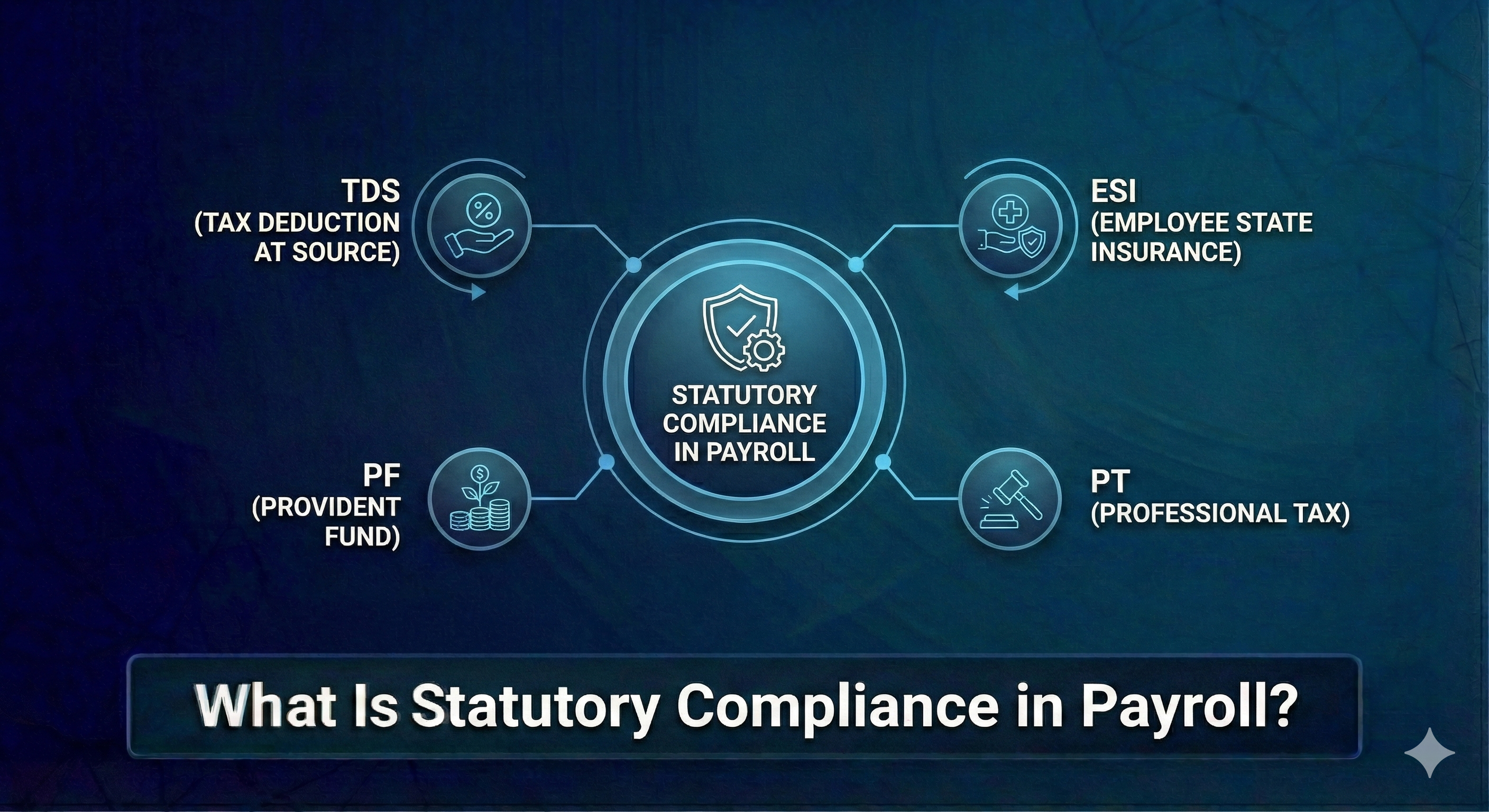
For today’s CEOs, CFOs, and CHROs, compliance is no longer a back‑office obligation it is a strategic business responsibility. In India, four statutory payroll components sit at the heart of employer compliance: Provident Fund (PF), Employees’ State Insurance (ESI), Professional Tax (PT), and Tax Deducted at Source (TDS). Together, they define how organisations protect employees, meet legal obligations, manage cash flow, and safeguard brand reputation.
This guide, What Is PF, ESI, PT & TDS? Explained for Employers, is written specifically for decision‑makers who want clarity without jargon. Whether you run a fast‑growing startup or a multi‑location enterprise, this blog explains not just what PF, ESI, PT, and TDS are, but why they matter at the board level and how modern HRMS platforms like JioHRMS help organisations stay compliant at scale.
Understanding Statutory Payroll Deductions in India
Before diving into each statutory component, it is essential to understand the broader compliance framework in which Indian payroll operates. Statutory payroll deductions are not optional benefits or discretionary policies; they are legally mandated financial responsibilities that employers must execute with accuracy and consistency. In practice, organisations act as custodians of employee contributions and government dues, ensuring correct deductions, timely remittance, and accurate reporting.
From a governance standpoint, statutory compliance directly influences financial integrity, audit readiness, and enterprise risk management. As organisations scale, payroll compliance evolves from an operational task into a systemic capability that must withstand audits, regulatory scrutiny, and employee queries without disruption. This makes payroll statutory compliance in India a critical pillar of sustainable business operations.
What Is Provident Fund (PF)?
The Employees’ Provident Fund (EPF) is a long‑term retirement savings scheme designed to provide financial security to employees after retirement or during emergencies.
PF Applicability and Employer Responsibility
Provident Fund applicability is defined under the Employees’ Provident Funds and Miscellaneous Provisions Act, 1952. Organisations employing twenty or more individuals are mandatorily required to register under PF, although many businesses voluntarily extend coverage earlier to build workforce trust. While statutory thresholds exist, leadership teams often view PF as a long-term investment in employee financial stability rather than a compliance checkbox.
Once covered, employers are responsible for calculating contributions accurately, maintaining employee records, depositing dues within prescribed timelines, and filing monthly and annual returns. Even minor deviations in wage definitions or delayed payments can compound into interest liabilities and penalties.
Why PF Compliance Matters to Leadership
From a C‑suite perspective, PF compliance for employers impacts:
Workforce trust and retention
Financial planning and provisioning
Employer brand credibility
Late payments attract interest and penalties, while non‑compliance can escalate into criminal liability for directors.
What Is Employees’ State Insurance (ESI)?
Employees’ State Insurance (ESI) is a social security and health insurance scheme that provides medical and cash benefits to employees during sickness, maternity, disability, or employment injury.
ESI Applicability and Employer Accountability
Employees’ State Insurance applicability is governed by workforce size and wage ceilings, which vary slightly based on state-specific notifications. However, the underlying responsibility remains consistent: employers must ensure that eligible employees are enrolled, contributions are calculated correctly, and benefits are accessible when required.
Unlike PF, ESI directly impacts employee well-being during periods of vulnerability such as illness, maternity, or workplace injury. For leadership teams, ESI is not merely a statutory expense but a mechanism that mitigates long-term medical and compensation risks.
Strategic Value of ESI for Employers
While often seen as a cost, ESI applicability and contribution reduce long‑term healthcare liabilities and demonstrate employer commitment to employee welfare an increasingly important ESG metric.
What Is Professional Tax (PT)?
Professional Tax (PT) is a state‑level tax levied on salaried employees and professionals. Despite its name, it applies to almost all forms of employment.
Professional Tax Governance for Multi-State Employers
Professional Tax is administered by state governments, making it one of the most fragmented statutory components in Indian payroll. Rates, slabs, exemptions, and filing frequencies differ across jurisdictions, which introduces complexity for organisations operating in multiple states.
Despite the relatively low monetary value, Professional Tax compliance requires precision. Errors often arise not from intent but from lack of system-driven enforcement, especially when employee transfers and location changes are involved.
Why PT Compliance Is Often Overlooked
Because PT rules differ across states, multi‑state employers face complexity. However, professional tax rules in India are strictly enforced, and non‑compliance can lead to cumulative penalties.
What Is TDS (Tax Deducted at Source)?
TDS on salary is a mechanism where employers deduct income tax at source based on an employee’s projected annual income and applicable tax slabs.
TDS on Salary: Employer’s Role in Tax Governance
Tax Deducted at Source on salary positions employers as the first point of tax collection for the government. This responsibility demands a clear understanding of income structures, exemptions, declarations, and evolving tax regulations.
TDS accuracy directly affects employee trust and organisational credibility. Under-deduction exposes employers to penalties, while over-deduction leads to employee dissatisfaction and reputational strain.
Importance of TDS for CFOs
From a financial governance lens, TDS on salary explained correctly ensures:
Accurate tax forecasting
Reduced audit exposure
Strong compliance ratings with tax authorities
PF, ESI, PT & TDS: A Unified Employer View
While PF, ESI, PT, and TDS operate under different laws, they intersect at payroll. Errors in PF ESI PT TDS calculation often arise due to manual processes, outdated rules, or fragmented systems.
For leadership teams, the challenge is not understanding the laws but ensuring consistent, error‑free execution across locations and employee categories.
Common Compliance Risks Employers Face
Incorrect wage definitions
Missed statutory deadlines
Manual calculation errors
Lack of audit trails
These risks scale exponentially as organisations grow.
How Modern HRMS Simplifies Statutory Compliance
This is where platforms like JioHRMS add strategic value not by replacing expertise, but by systematising compliance.
JioHRMS helps employers:
Automate statutory deductions in payroll
Apply state‑specific PT rules automatically
Generate PF, ESI, and TDS challans and reports
Maintain audit‑ready compliance records
Importantly, compliance becomes a by‑product of payroll, not a separate operational burden.
EEAT Perspective: Why Trustworthy Compliance Matters
From an EEAT (Experience, Expertise, Authority, Trustworthiness) standpoint:
Accurate compliance reflects organisational maturity
Transparent payroll builds employee confidence
Structured systems reduce dependency on individuals
Boards increasingly evaluate compliance frameworks as part of enterprise risk management.
Final Thoughts: Turning Compliance into Competitive Advantage
For modern organisations, statutory compliance is no longer about avoiding penalties it’s about building trust, resilience, and scalability. Leaders who clearly understand PF, ESI, PT & TDS are better equipped to make informed workforce and financial decisions.
If your organisation is scaling and payroll complexity is increasing, it may be time to evaluate whether your current systems are future‑ready. Explore how a unified HRMS approach can turn compliance into confidence for leadership and employees alike.