 What Is HRMS Architecture?
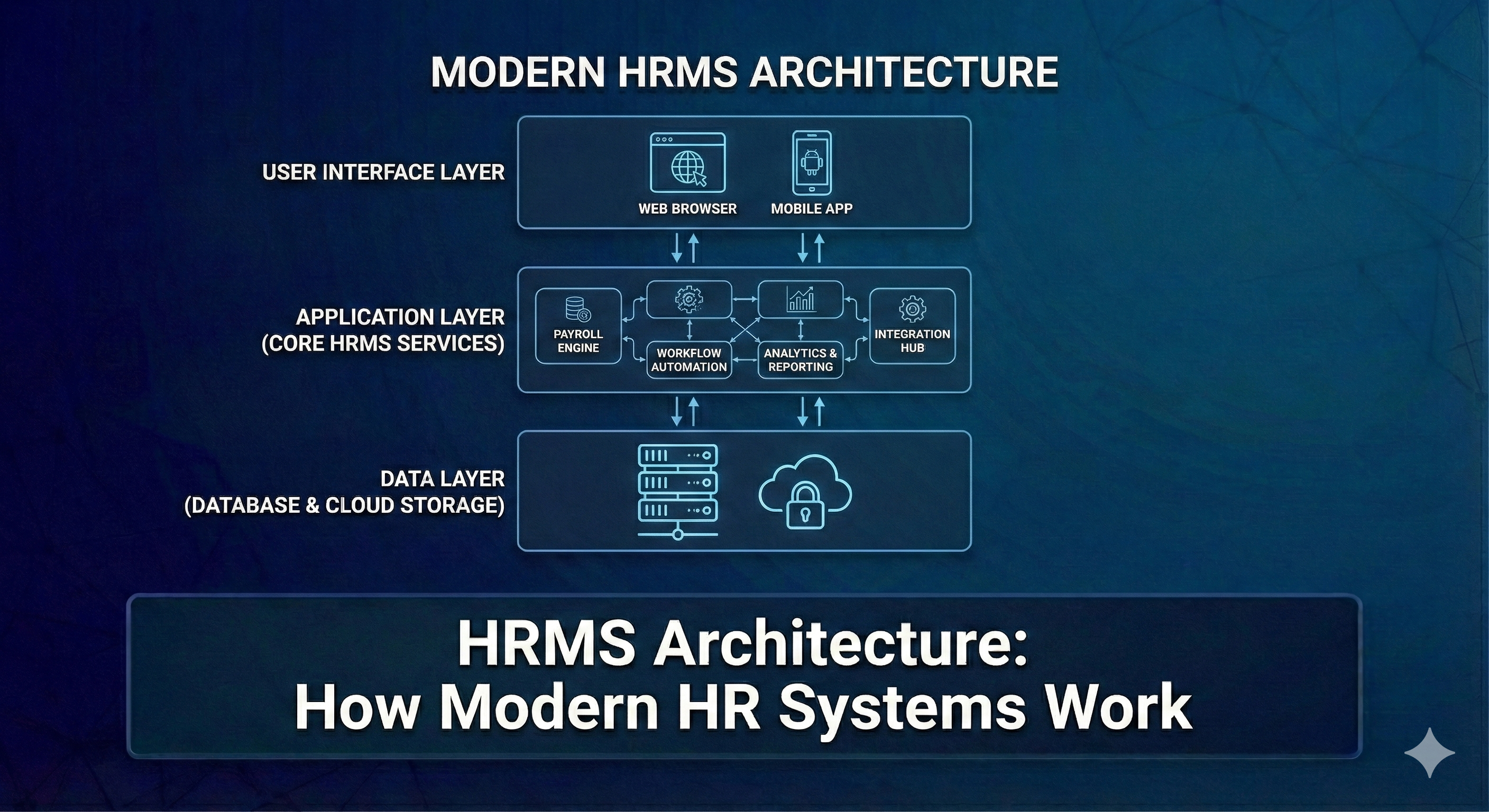
HRMS Architecture: How Modern HR Systems Work

Why HRMS Architecture Matters to the C-Suite
For today’s leadership teams, HR technology is no longer a back-office utility it is a strategic operating system for people, productivity, and performance. Yet many CXOs invest in HR software without fully understanding how it actually works under the hood.
That “under the hood” foundation is known as HRMS architecture.
In simple terms, HRMS architecture defines how an HR system is designed, how its components interact, how data flows, and how securely and efficiently the system scales as the organization grows. For enterprises dealing with distributed teams, compliance complexity, real-time reporting, and AI-driven decision-making, architecture is not a technical detail it is a business risk or advantage.
This guide explains HRMS architecture from a leadership lens, breaking down complex system concepts into clear, business-relevant insights so you can make confident, future-proof HR technology decisions.
What Is HRMS Architecture?
HRMS architecture refers to the structural blueprint of a Human Resource Management System including its layers, components, data models, integrations, and security framework.
It defines:
How employees and HR teams interact with the system
How HR processes are executed and automated
How data is stored, processed, analyzed, and protected
How the HR system integrates with finance, IT, payroll, and third-party tools
A strong HR system architecture ensures that HR operations remain scalable, compliant, resilient, and insight-driven, even as organizational complexity increases.
Why HRMS Architecture Is a Strategic Priority for Enterprises
Many legacy HR tools fail not because of missing features, but because of poor architectural design. For the C-suite, this has real consequences.
A well-designed hrms architecture enables:
Faster decision-making through real-time workforce analytics
Seamless scaling across locations, headcount, and geographies
Stronger compliance with labor laws, audits, and data privacy
Reduced operational risk and system downtime
Better employee experience through unified digital workflows
Conversely, weak architecture leads to data silos, manual workarounds, security vulnerabilities, and limited visibility all of which impact business performance.
Evolution of HRMS Architecture: From Legacy to Modern Systems
Traditional HR Software Architecture
Older HR systems were typically:
On-premise
Monolithic (single, tightly coupled system)
Difficult to upgrade
Poorly integrated with other enterprise tools
Any change new policy, compliance update, or reporting requirement often required custom development and downtime.
Modern HRMS Architecture
Modern HR platforms use:
Cloud-native infrastructure
Modular and microservices-based design
API-driven integrations
AI-ready data layers
This shift allows HR systems to evolve continuously without disrupting operations an essential requirement for today’s agile organizations.
Core Layers of Modern HRMS Architecture
To understand how modern HR systems work, it helps to view HRMS architecture as four interconnected layers.
1. Presentation Layer (User Experience Layer)
This is the interface where users interact with the system.
It includes:
Employee self-service portals
Manager dashboards
HR admin consoles
Mobile and web applications
A well-designed presentation layer ensures:
Intuitive navigation
Role-based access
Consistent user experience across devices
Platforms like JioHRMS prioritize clean UX and responsive design, enabling faster adoption and reduced training effort across the workforce.
2. Application Layer (Business Logic Layer)
This is where HR processes actually run.
The application layer manages:
Attendance rules
Leave policies
Payroll calculations
Performance workflows
Compliance logic
Each function is typically built as an independent service, allowing organizations to enable or disable hrms modules as needed.
This modular approach ensures flexibility without system disruption.
3. Data Layer (Database & Analytics Layer)
The data layer is the single source of truth for workforce information.
It stores:
Employee master data
Attendance logs
Payroll records
Performance metrics
Compliance documentation
Modern hr software architecture uses structured databases combined with analytics engines to deliver:
Real-time reporting
Predictive workforce insights
Audit-ready data trails
Strong data architecture is critical for regulatory compliance and AI-driven decision-making.
4. Integration Layer (API & Ecosystem Layer)
No HR system operates in isolation.
The integration layer connects HRMS with:
Payroll and finance systems
Accounting software
Biometric devices
ERP platforms
Third-party apps
A robust HR system architecture uses secure APIs to ensure seamless data flow without duplication or delays.
Key HRMS Modules and How They Fit into the Architecture
Modern HR platforms are built around configurable hrms modules, each aligned to a business function.
Core HR Module
Manages employee profiles, organizational structures, and documentation.
Attendance & Leave Module
Captures time data, applies policies, and ensures payroll accuracy.
Payroll Module
Processes salaries, deductions, statutory compliance, and payslips.
Performance Management Module
Supports goal setting, reviews, and continuous feedback cycles.
Compliance & Reporting Module
Ensures adherence to labor laws and audit readiness.
Each module functions independently but shares a unified data foundation one of the biggest advantages of modern hrms architecture.
Cloud-Based HRMS Architecture: Why It Dominates Today
Most modern HR systems now operate on cloud infrastructure, offering distinct advantages for enterprises.
Cloud-based HRMS architecture provides:
On-demand scalability
Automatic updates and compliance patches
High availability and disaster recovery
Lower infrastructure costs
JioHRMS follows a cloud-first architectural approach, ensuring organizations can scale without re-engineering their HR systems.
Security and Compliance in HRMS Architecture
For leadership teams, data security is non-negotiable.
Modern HRMS architecture includes:
Role-based access controls
Data encryption at rest and in transit
Audit logs and activity tracking
Compliance with local labor and data protection laws
A well-designed HR system architecture minimizes risk while maintaining transparency and trust.
AI and Analytics in Modern HRMS Architecture
HR is becoming increasingly data-driven.
Modern hr software architecture supports:
Predictive attrition analysis
Workforce planning insights
Performance trend forecasting
Automated compliance alerts
This is possible only when the HRMS architecture is designed with clean data pipelines and analytics layers from the start.
How HRMS Architecture Impacts Business Outcomes
For CXOs, architecture decisions translate directly into business results.
A strong hrms architecture enables:
Faster hiring and onboarding
Accurate payroll and compliance
Better employee engagement
Real-time workforce intelligence
Reduced operational risk
In contrast, fragmented systems create blind spots that slow growth and increase cost.
What CXOs Should Evaluate Before Choosing an HRMS
When evaluating HR platforms, leadership should ask:
Is the architecture modular and scalable?
Can it integrate easily with our ecosystem?
Is data centralized and analytics-ready?
How strong is the security framework?
Can the system evolve with AI and automation?
Solutions like JioHRMS are built around these architectural principles, enabling long-term value rather than short-term feature adoption.
The Future of HRMS Architecture
The next evolution of HRMS architecture will focus on:
AI-native systems
Hyper-automation of HR workflows
Deeper analytics and predictive modeling
Unified employee experience platforms
Organizations that invest early in modern architecture will gain a structural advantage in managing talent at scale.
Conclusion: Architecture Is the Foundation of HR Excellence
Choosing an HR system is not just about features it is about how those features are architected, connected, secured, and scaled.
A modern, well-designed HRMS architecture empowers leadership with clarity, control, and confidence in workforce decisions. It transforms HR from an administrative function into a strategic growth engine.
For enterprises navigating complexity, compliance, and competition, architecture is no longer optional it is essential.
Looking for the Best Online HR Software? Check out the Best Online HR Software .