 Understanding the Payroll Management System in the Indian Context
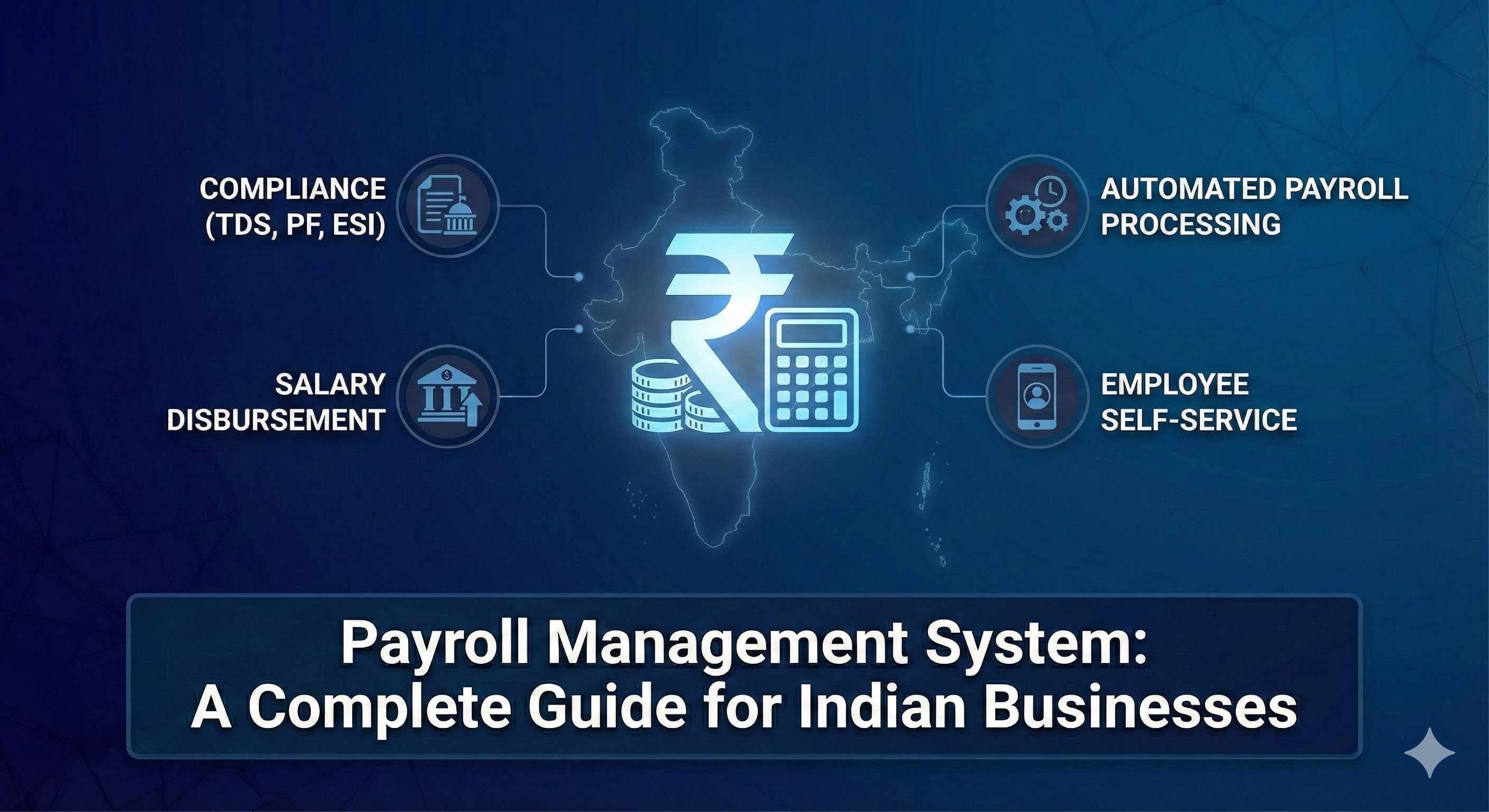
Payroll Management System: A Complete Guide for Indian Businesses

Introduction: Why Payroll Has Become a Strategic Leadership Issue
In Indian organizations today, payroll is no longer a routine back-office activity managed quietly by HR or finance teams. It has evolved into a strategic business function that directly impacts compliance posture, employee trust, cost control, and leadership credibility.
As businesses scale across cities, states, and workforce models, payroll complexity increases exponentially. Indian labor laws, tax regulations, and statutory requirements are among the most detailed globally. A single miscalculation can lead to penalties, audits, employee dissatisfaction, or reputational damage.
This is why modern organizations are rethinking how they manage payroll. A robust payroll management system is now viewed not as an operational tool, but as a risk-mitigation and governance mechanism that supports sustainable growth.
This guide is designed for founders, CXOs, CFOs, and CHROs who want a complete, strategic understanding of payroll in India how it works, why traditional methods fail, and what leadership teams should look for when adopting a future-ready payroll solution.
Understanding the Payroll Management System in the Indian Context
A payroll management system is a centralized digital framework that automates and governs the entire employee compensation lifecycle. It ensures that salaries are calculated accurately, statutory deductions are applied correctly, compliance requirements are met on time, and records remain audit-ready.
In India, payroll goes far beyond salary credit. It includes handling Provident Fund contributions, Employee State Insurance, Professional Tax, income tax deductions, labor welfare fund obligations, and state-specific regulations. Each of these elements is governed by distinct laws, thresholds, and timelines.
What makes a payroll system indispensable is its ability to bring consistency and predictability to this complexity. Instead of relying on individuals, spreadsheets, or fragmented tools, organizations rely on systems that institutionalize accuracy and compliance.
How Payroll Actually Works in Indian Organizations
For leadership teams, payroll often appears deceptively simple: calculate salaries and pay employees. In reality, payroll in India is a multi-stage process that requires precise coordination between HR, finance, and compliance functions.
Payroll begins with attendance and leave data, which forms the foundation for salary calculations. Earnings are then computed based on defined salary structures that typically include basic pay, allowances, reimbursements, and variable components. Deductions are applied according to statutory rules and employee-specific declarations.
Finally, statutory liabilities are calculated, payslips are generated, salaries are disbursed, and compliance filings are prepared. Each step is interdependent, and errors in early stages cascade into larger problems downstream.
A modern payroll processing system ensures that this entire flow runs seamlessly, month after month, regardless of workforce size or geographic spread.
Why Manual and Spreadsheet-Based Payroll No Longer Works
Despite advances in HR technology, many Indian organizations still rely on spreadsheets or semi-manual processes. While this may appear cost-effective initially, it introduces significant operational and compliance risk as organizations grow.
Manual payroll processes depend heavily on individuals rather than systems. Knowledge resides in people, not platforms. When key personnel leave, errors increase. Regulatory updates may be missed. Calculations become inconsistent. Audit readiness suffers.
From a leadership perspective, this creates unnecessary exposure. Payroll mistakes are highly visible to employees and regulators alike. Over time, the cost of errors, rework, and penalties far exceeds the investment required for a reliable payroll management system.
The Business Value of a Payroll Management System
For Indian businesses, the value of payroll automation goes well beyond efficiency. At a strategic level, it provides leadership teams with control, predictability, and confidence.
One of the most significant benefits is built-in statutory compliance. Payroll systems designed for India automatically apply the latest PF, ESI, PT, and tax rules. This reduces reliance on manual interpretation and minimizes compliance risk.
Accuracy is another critical advantage. Automated calculations eliminate common human errors related to formulas, thresholds, and prorations. This results in fewer disputes, corrections, and escalations.
Time efficiency also improves dramatically. What once took days of coordination between teams can now be completed in a structured, repeatable manner. This allows HR and finance leaders to focus on strategic initiatives rather than administrative firefighting.
Equally important is employee trust. Timely, accurate salaries and transparent payslips contribute directly to engagement and retention factors that leadership teams increasingly prioritize.
Payroll System India: Complexities That Global Tools Often Miss
India is a uniquely complex payroll environment. A payroll system India must be designed with local realities in mind, rather than adapted from global payroll models.
Multi-state operations introduce varying professional tax slabs, labor welfare fund rules, and minimum wage notifications. Salary structures are highly customized, with flexible allowances and variable pay components. Tax declarations and exemptions require careful handling throughout the financial year.
Generic payroll solutions often struggle to accommodate these nuances. Indian businesses need systems that are natively aligned with local regulations, not retrofitted for them.
Payroll Software India vs Payroll Outsourcing: A Strategic Perspective
Leadership teams often evaluate payroll outsourcing as an alternative to in-house systems. While outsourcing can reduce initial effort, it also limits control and transparency.
With payroll software India, organizations retain ownership of their data, gain real-time visibility into payroll costs, and reduce dependency on third parties. Over time, software-driven payroll models tend to be more scalable and cost-efficient.
Outsourcing, on the other hand, introduces recurring costs, slower turnaround times, and potential data security concerns. For organizations focused on long-term growth, internal capability enabled by the right payroll system often proves to be the more resilient choice.
What Leaders Should Look for in a Payroll Management System
Choosing a payroll management system is a strategic decision that affects compliance, finance, and employee experience.
Leadership teams should evaluate whether the system supports complex Indian salary structures, multi-location compliance, and seamless integration with attendance and leave management. Security, audit trails, and reporting capabilities are equally important.
Modern platforms such as JioHRMS are built with these realities in mind. By embedding Indian compliance logic and integrating payroll with broader HR workflows, such systems reduce friction while maintaining accuracy and governance.
How JIO HRMS Fits Into a Modern Payroll Strategy
Rather than positioning payroll as a standalone tool, JioHRMS approaches it as part of an integrated HR ecosystem. Payroll is closely connected with attendance, leave, and employee data, ensuring consistency across systems.
For leadership teams, this means fewer data silos, more reliable reporting, and greater confidence in payroll outcomes. The system is designed to quietly handle complexity while allowing decision-makers to focus on growth, compliance, and workforce strategy.
Importantly, the value lies not in aggressive promotion, but in dependable execution something CXOs increasingly prioritize.
Make your HR Software fun and easy!
Learn how JIO HRMS Software can help you automate HR processes and stay 100% compliant.
Data Security and Governance: A Boardroom-Level Concern
Payroll data is among the most sensitive information an organization holds. Any breach or misuse can have serious legal and reputational consequences.
A robust payroll management system must enforce strict access controls, encryption, and audit logs. Leadership teams should be able to trace who accessed data, when, and why. These capabilities are no longer optional; they are essential elements of corporate governance.
Cloud-Based Payroll Systems and the Future of Work
Cloud adoption has fundamentally reshaped how Indian businesses operate. Payroll is no exception.
Cloud-based payroll systems offer faster updates, easier access, improved resilience, and lower IT dependency. They are particularly valuable for organizations with distributed teams, remote work models, or rapid expansion plans.
As compliance requirements evolve, cloud platforms ensure that updates are applied automatically, reducing operational burden on internal teams.
Measuring the ROI of a Payroll Management System
For CXOs, every technology investment must demonstrate clear returns.
The return on a payroll management system is visible in reduced errors, lower compliance risk, improved employee satisfaction, and better financial visibility. Over time, these benefits compound, making payroll automation a financially sound decision rather than a cost center.
The Future of Payroll in India
Payroll is gradually evolving from a transactional process into a source of strategic insight. Advanced systems are beginning to offer analytics on workforce costs, compliance exposure, and compensation trends.
Organizations that invest early in modern payroll infrastructure will be better positioned to adapt to regulatory changes, workforce shifts, and evolving employee expectations.
Final Thoughts: Payroll as a Leadership Responsibility
Payroll reflects how an organization values its people, respects the law, and manages risk. For Indian businesses navigating scale and complexity, getting payroll right is not optional it is foundational.
A well-implemented payroll management system provides leadership teams with confidence, control, and clarity. It transforms payroll from a monthly challenge into a stable pillar that supports sustainable growth.